Hey hey, my my, another year's gone by! Shall we have a quick look on what has happened on the music side of affairs and ask Caspar what were his personal favs in 2013?
Live.
Obviously, Caspars first-ever live show of Neil Young is right up there. As he wrote in his blog in June (Casparlive: Neil Young and Crazy Horse), it wasn't the best show ever, but what a joy to see your old hero still rocking. To realize that his songs are still vivid, his guitar solos still long and loud, and his band of brothers Crazy Horse still the compact rocking motor they always were.
Old, but new (to me).
I can't help to think sometimes that you essentially know it all. Back when I was still a teenager, I remember discovering Lou Reed, when my brother bought New York, the album. I also remember hearing Nick Drake for the first time (when a friend-in-the-band played it to me), but it had been a while since I discovered something new, but old, that blew me of my socks. Somehow, in 2013, I came across the band Television, with their album Marquee Moon (1977). Great double-guitar work, great songs, punky attitude, and , a psycho drive to the vocals. Old, but new to me!
New, in the 2013 sense of the word. I guess that must have been Brendan Benson. I knew the name before, but only in 2013 did I discover his own music, both on CD, as live. What makes me very happy, is that Benson was good, but not at his best when Caspar saw him live (casparcritique Brendan Benson live), but he took a good revenge organizing a gig with special guests like his musical buddy Jack White, Jacob Dylan, and Ken Stringfellow, amongst others. Plus, he recorded a great new album called You Were Right. Great that I finally got to get to know you, BB, you're my personal new-comer of the year!
Best debut 2013.
As far as you know Caspar, you know that it usually takes some time before he decides it's a thumbs up, or not. So, for him to actually pick something brand new, is quite difficult. Well, to be honest, he made a very swift pick choosing Jonathan Wilson, but after he discovered that Wilson's 2013 album Fanfare wasn't his debut, it took some time to find something else. But, as Caspar's good friend Niels'd say: pick one or die, the best debut for Caspar was by a Dutch guy called Jacco Gardner. A young lad using gear from the sixties, sounding like early Pink Floyd, but with his own quality song material.
Dead in 2013.
Unfortunately, but unavoidably so, the world will have to do without a number of great musicians. Lou Reed, Ray Manzarek, George Duke, just to name a few. On a personal note, Caspar said that the death of JJ Cale, fantastic songwriter and guitarist, was his biggest loss of the year. You might consider that Lou Reed, with his revolutionary work, his legacy with so many historic albums, is the bigger star. But that is exactly why Caspar chose Cale; JJ felt more like a friend, easily approachable, sweet, laidback guitar tunes, and, don't forget, some classical tunes to his name!
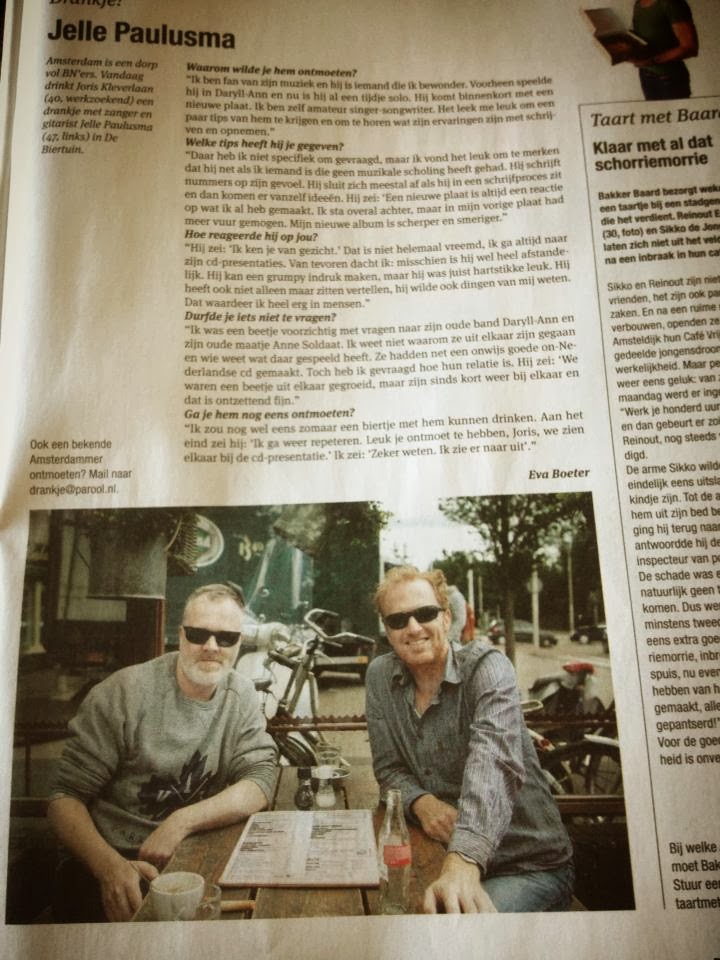 Finally, a personal highlight of the year is when I met up with Jelle Paulusma, singer-wongwriter from Amsterdam, to be interviewed in Het Parool. We talked about his former band Daryl-Ann, and how his relation was to Anne Soldaat, the 'other' singer-songwriter from Daryl-Ann, nowadays. His answer was that they were on 'speaking terms'. Only about two months later they announced their plans for reuniting the band in 2014! (Jelle: too bad your new CD is postponed because of this ;-))
 This blog is a-long time coming. Somehow it has been on my mind for some time, without concretizing. So now here it is, a critique on Dead Man, a great movie by Jim Jarmusch, but even more importantly to the CasparBlog: with a score by one of Caspar's favorites: Neil Young.
Now, maybe one of the reasons on hesitating to write this particular critique, was the question on my mind if I should go into Jarmusch' body of work, or stick by Young's music, because this blog is about music. But hey, I can write about my passions, right? And, so far the blog has written substantially about music in combination with documentaries. So, Caspar, don't hesitate, just rattle on! From the eighties onwards I have been following Jarmusch' carreer from a distance. Back then I remember seeing Down by Law, with Tom Waits in one of his character roles as a runaway convict. Shortly after I learned that Waits was actually a singer-songwriter, and my first encounter with his talent was his live album Big Time, starting with the unforgettable words 'good evening' in his hoarse, low voice. Another Jarmusch film I remember vividly was Night on Earth, with Roberto Benigni impersonating a sodomized sheep, getting the priest in his cab to die from a heart attack. You can imagine Jarmusch made quite an impression on young Caspar...
As we discussed in an earlier CasparCritique (CasparCritique: Year of the Horse), somewhere midway the Nineties, Jarmusch and Neil Young made a deal. Young would provide Jarmusch' new movie with a sound track, and as a return of favor, Jarmusch would make a documentary of Neil Young and Crazy Horse. On a personal note, Caspar gave the documentary 4 stars, but apparently, Neil Young wasn't very happy with the result. Do we think that Jarmusch was happy with the music score? I bet he did. The movie Dead Man was Jarmusch most expensive movie, and maybe his shot at becoming a bit more main stream (Caspar strongly advises not to take any of his apparent knowledge of movies too seriously), and the score made by one of the USA's big selling artists would certainly help in that respect.
Back to business Caspar, let's talk a little on the sound track. When I sat down the other day to watch the movie, I had no idea what to expect. As the movie is from 1995, I realized that Young's projects just before that were collaborations with Pearl Jam (Mirror Ball), and Crazy Horse (Sleeps with Angels). So, both band-, and rock oriented, although Sleeps with Angels was a bit more gloomier. But surprisingly Young's contribution to Dead Man is solo work. At the very start of the movie, you can hear Young's Gibson valve ampifier turned on loud. Then he starts hitting the strings slowly with the outer side of his hand, making a sort of thumping sound. With his pick, or plectrum, he scribbes notes and phrases, that because of the reverb in the amplifier, and probably some slight echo effect, gives a big sound like he'd be recording in a church. This is what continues throughout the movie, with the only, apparent, difference that he goes faster bit by bit, thus giving the movie a pace like a steam train slowly speeding up towards the end of the story. And I must say: a nice story it is. Leading character Johnny Depp as an accountant in the Wild West, getting into more and more trouble, and finally saved (or is he?) by an indian called Nobody.
I enjoyed the movie very much, and I thought the music accompanied it
effectively. Also it fits in with Young's carreer for being different than
the usual. If I'd had to give it marks, I'd give it five stars out of five. Not for being amongst Neil's best work, but for being the perfect accompaniment to one of Jim Jarmusch's master pieces.
A final thought would be on the accurateness of what you just read. Maybe what I just told you, on the technical side of things, and the substance of the sound track, could be wrong. The interesting part for me is that this CasparBlog is an account of watching a movie once, late night, and then telling about the score a few months later.
Wow, this was kind of heavy. After seeing Neil Young and Crazy Horse play live last night, now Caspar saw them again in this documentary by Jim Jarmusch. It was like you saw the show again, but in another year, another place, and more up close. In all its raw, 8 mm filmed material, with short introductions of the band members , its history and life on the road, the film does justice to its subject: four guys, two guitars, a bass and drums, plus a basket full of great songs; rock 'n roll in its purest form!
As I mentioned yesterday, I hadn't seen Neil Young and Crazy Horse live before. Funny enough, it was the documentary The Year of the Horse that I saw twice already when it was released in 1996, at the Filmmuseum in Amsterdam. What struck me most back then was the loud and intense way Neil and the band played. I really liked it; most of the songs in the film I knew already and I related to (see:CasparLive: Neil Young and Crazy Horse). Peculiar how that CD was released under the same name, but contains a very different set of songs. Now, after having seen the live show, I thought the film even more impressive. We get so close, almost as if we are on the stage with them. But do not think you can get in between them somehow. The movie shows clips from the past when the band was fighting over the vocal parts, but if there is anything clear that we get from the film is that this is a very tight band, both musically and personally.
Funny how the film has been critized by various people over the choice of Jim Jarmusch to use 8 mm film. It gives the film a grainy touch, which is amplified by editing loosely shot material for example looking outside from the touring bus while on the road. This choice can be explained two ways. From the one hand it might give the movie a sort of artsy fartsy look (dixit guitarist Poncho Sampedro), that combines nicely with Jarmusch' image as the intelectualist, New York film maker. But on the other, we can say that it supports Crazy Horse's raw music, and characters. Anyhow, in my opinion it works well. The film is a nice pastiche, with great live performances, and some more or less pivotal scenes from the past, and short interviews with the guys, Neil's father, and their long standing manager Eliot Roberts (see also: CasparCritique: David Geffen always wins). This way we get the whole picture and introduction to the band in a great way. Surely, as Poncho Sampedro states three times, the film maker will not tell the whole story on the basis of a few questions and in two hours, but that would mean that the story could not be told by anyone. So, this is comes close enough.
One last thing that struck me was that guitarist Sampedro and bass player Billy Talbot apparently do not use any effects, or guitar tuning. Now that I think of it, also Neil himself is able to force his guitar to the max getting feedback from his amps, still being able to play the intro to Hurricane afterwards in a tuned way. Also, the way they stay close to eachother on a stage, no matter how big it is; they're in it for the music, and their love of noise. After so many years, so many stories, so many songs and so many tours, Neil Young and Crazy Horse are still the same guys as they were before. No pretentions, plug in your guitars and let's rock! This way, a movie can hardly ever go wrong for me; I'll give it 4 stars out of five!
Back in the days, when I was just seventeen, I fell for this real cool hippy girl, and she introduced me to Neil Young. Though I did know the name Neil Young, I didn't know his music. So she made a cassette for me with, what she considered, his best work. I remembered the exact moment, the surroundings and all, when I put the cassette in my Sony Walkman, and heard his voice for the first time. That first song was The Loner, man that really got me: Neil sang exactly about things I felt back at that period of my life...
Anyway, nothing too spectacular happened between me and the girl (well nothing as spectacular to tell you...), and even though I stayed fan, learned to play and sing his songs, I never got around to see Neil perform live. So, last night, finally, after all these years, I went to the Ziggo Dome venue in Amsterdam to see my hero play live. Such a feast to see the huge five meter high amplifiers on the stage, still in their flightcases when Los Lobos were playing the opening show. As I remember from photos and stories by others, these stage items were already used on the Rust Never Sleeps tour in 1978, when the roadies were dressed as monks, with wide capes covering their faces. Now the roadies dress as docters, and construction workers, and I still don't know why but who cares.
From the moment the Beatles song A Day in the Life was heard, everybody knew that Neil and Crazy Horse were about to enter the stage and you could sense the excitement rising. What followed was maybe not Neil's best show ever, but as he said himself: not every show can be great. For me, it was the coming together of decades of sentiments and musical inspiration. The man was there, he moved around stage with his long legs, a bit clumpsy, but just very intense playing, staying close to his fellows of Crazy Horse. Maybe that is what I liked most: though these musicians have been around for decades, they're still in it for the love of music. So, they do not try to occupy the whole stage, but rather stay close to each other concentrating on what the others are doing. Also, they do not change instruments all the time, but they use the ones they like most, with Neil's Old Black center stage: the legendary Gibson Les Paul he has used for most of his recordings and shows.
For all of his hours of beautyful, emotional music, for his great contributions to country-rock, punk-rock, grunge and all other guitar-based music, for his fantastic songbook and the inspiration he has given us, and most of all, for giving my emotions a voice when it needed one so badly, Neil Young gets all of the five stars I have available. On a more objective note, last night's show gets four. But nevermind, we're not done yet with Neil 'Shakey' Young; tonight I'll have another look at the Jim Jarmusch' documentary Year of the Horse at the Melkweg venue. Tomorrow another CasparCritique!? See you there!
